What have you learned about your own creative processes through this creative project?

Prior to this course, I always thought of myself to have zero creativity juices. However, as I learned the various frameworks in this course, I tried to implement as many as I can both to this creative project as well as to my daily life.

For my project, the main concepts I used were blending as well as SCAMPER. These were the two that really shaped my thinking towards the idea of creating Revitlab.

With regards to blending, I tried to think of two ideas that had little to no correlation, and blend them together into a feasible concept that could potentially work.

With regards to SCAMPER, I followed the framework by trying to really implement each and every letter, substituting, combining, adapting (etc.) different products and ideas in order to achieve a feasible business plan.

I learned that I have been able to follow the frameworks of creativity in order to boost my own creativity. Like I said, I was never the most creative person. But now, I realise that I can actually try to make myself become more creative with the help of such frameworks. Also, I now learn to see things in a different perspective, having a better understanding of things by putting myself in eyes of others and looking at everything with a lens that I previously did not own.

What is your own personal critique of your creative project?

In my opinion, I’d think my project would probably be one that is feasible, realistic, scalable and profitable as a business in the long run.

I had two input spaces in mind, 1) Reducing waste of the environment 2) Finding a healthier alternative to curb the rising levels of sugar concern amongst the population. I wanted to find a business solution that could combine said concerns that would be profitable for me.

This business is actually something that I have been thinking about personally, as a friend of my recently started to open a cafe , which turned out to be pretty affordable. While we were discussing about his opening, he mentioned to me how he blended his two concerns into one blended space to come up with the concept. Of course he did not have the concepts of input spaces or nor blending, but this was where I started to realise that subconsciously everyone had something like that in mind without realising their creativity potential.

In order to develop on my cafe concept, of course much more thought processes must be put in place to ensure the cafe kicks off. However, when thinking of a business idea, I have never thought of using creativity to as part of my logic flow in order to create a business plan. Maybe subconsciously, but never actively. Especially with the framework of SCAMPER, I now can incorporate these frameworks into my thinking and logic flow, which can potentially help me solve gaps I never considered.

How does your creative output relate to the working definition of creativity introduced in this course?

Throughout the course, while we learned many different aspects of creativity and how different components all adds up and are all relevant, I think the one word that stood out to me with regards to creativity was “considered”. With that word in mind, I started to look at everything with different perspectives, trying to put myself into the shoes of others in order to appreciate creativity from their viewpoint.

“Better to write for yourself and have no public, than to write for the public and have no self” – Cyril Connolly

This phrase showed in class really got me thinking about various perspectives, and how the term “considered” really plays a huge role in measuring creativity.

With that in mind, my idea to open this fruit juice cafe using ugly fruits might not be the most revolutionary nor mind-blowing idea, but it was one which in my opinion, was a creative blend between two separate input spaces to generate a solution. With this idea, creativity within my idea revolves around my endeavour that is considered new and optimal that brings benefits and value to the environment and also my target market.

Why did you produce this creative output? What creative perspectives or processes did you apply?

I came up with this idea based on the concept of blending. With Revitlab, I was able to blend two input spaces into one blended space to create something that solves a market gap and could potentially be profitable and scalable. I was able to blend fruit wastage with healthier alternatives to soda and bubble tea into a blended space of fruit juice using wasted fruits. This then allowed me to amplify on the concept and create a fruit juice cafe.

Always keen on the entrepreneurship side of things, I wanted to create a product and business which was not just based on what I wanted to sell, but also based on what people were interested in buying.

Instead of trying to create something that I would not be able to resonate well with, I was looking at creating something that I really liked and saw potential in. Looking into successes of other businesses in mind, such as the Acai Affair, I implemented the SCAMPER framework to workaround my concept and tried to make it better.

Creative Project – Revitlab

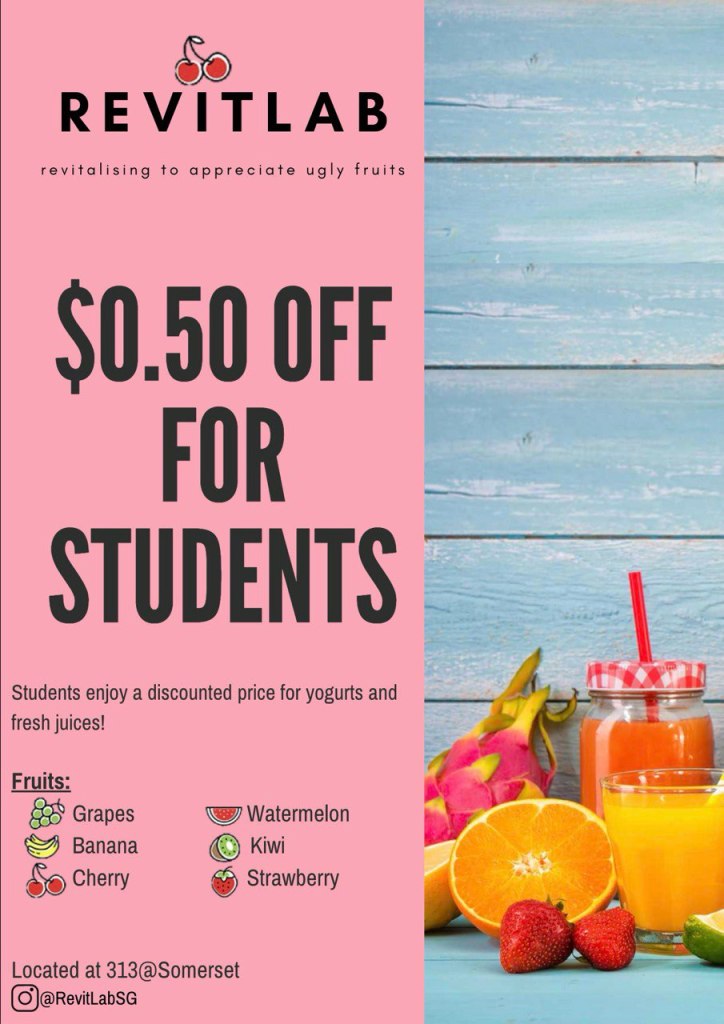
I aim to open a fruit juice cafe, Revitlab, with the main purpose to revitalise “ugly fruits” into different products such as fruit juice and açai bowls. These “ugly fruits” usually gets discarded by farmers and supermarkets for not making the aesthetic cut, though they taste the same and still have high quality. This not only helps to reduce fruit waste in Singapore, but also lowers my cost price of each products, increasing my profit margin.

There is a market gap for healthy, sweet drinks. Fruit juice is a healthier alternative for both soda and bubble tea, which are high in demand among youths and younger working professionals. However, with the population now acknowledging the importance of a healthier diet and hoping to find a healthier alternative, I believe fruit juice would prove to be a good substitute to replace their cravings. My fruit juices will be priced lower than the competition due to my lowered cost of ingredients. This price advantage along with the narrative of reducing wastage would be part of my appeal to gain market share.


#3 Reflection of my CT Journey

My creative thinking journey so far has been one of surprise. From being able to view anything with multiple, new angles, to having a new perspective to the fundamentals of “creativity”, it was something I truly did not expect to takeaway from this course.

The biggest takeaway for me so far has been the creative technique of blending. While the idea of blending is not something new to me, recognising the said technique as a technique is new and eye opening to me. When I first learned in class about the concept of blending two “input space”s into one “blended space”, I initially thought it was a rather forceful concept, trying to break up one’s creativity by working backwards. However, I slowly realised it was due to my lack of creativity in not acknowledging the various perspective I can view things that ultimately restricted my capacity to appreciate such creativity concepts, this has been a big change thus far.

Bringing over this change in perspective and newly found “blended space” concepts into my everyday life, I have started to be more open, think more out of the box, and appreciate more activities that revolve around my daily life. Even now, the concept of ordering my daily “yuan yang” – a mix of coffee and tea, has triggered a “blended space” conceptual theory in my brain, a crazy thought I’d never have ever thought about. This eventually led me to start mixing new ingredients (input space) and making new drinks, with my newly found favourite milo with coffee. If you have not, please try it. Hopefully your one key takeaway from my reflection could be this creation of milo coffee if you’ve never tried!

Creative thought leadership in “Zombie roaches and other parasite tales”, by Ed Yong

This video is popularly considered a piece of thought leadership simply because it is able to not only simplify, but also blend humor into an understandable narrative for the layman who have no knowledge in the field to understand a complicated situation. Personally, I thought it was a fantastic video. Firstly, the speaker was creative in his use of implicit jokes which required a level of understanding – which he has given – to understand the humor. The laughter amongst the crowd not only humored them, but also gave them a level of satisfaction and pride whereby they were able to acknowledge and be acknowledged to have a level of intellectual capacity. This was him putting into action the manipulation he was sharing about. Him cracking the joke to make the crowd laugh was similar to be a parasite, he was controlling the minds of the audience. 

Ed Yong, was able to blend the examples of living organisms to drive points across, albeit subtly, in order to convey powerful messages without being too direct. This whole video was an example of an example he raised, whereby many things are easy to overlook, which does not mean it isn’t important. It invokes a self-reflection upon watching the video, whereby manipulation is common around us, and we know it. We tend to overlook unfavorable things in our lives, even though they aren’t unimportant. Sometimes, we, like the roach, are injected with venom to uncheck the escape from danger box. However, the venom we are injected with, varies between person to person. Are you being manipulated? Maybe, probably, likely. Can you, however, control your behavior and suppress unwanted consequences from eventually happening? Yes, you definitely can. Open your eyes, focus on the end goal, be the tape worm, not the Artemia. 

My Reflection Journal

When I was 11, I succumbed to the trading card craze. Every dollar of pocket money I received, I spent it on a trading card game – Duel Masters. Soon, envy and greed got the better of me and I needed better cards, which were naturally more expensive. I had to find a way to make more money to increase my purchasing power. I started first with barter trade, before starting to sell rare, exclusive cards at a high price. I then used the money I earned to “reinvest back into my business”, buying more cards before repeating the process again. Within a couple of months, I earned close to $1000 just from this trading card game, which was quite a feat for a 11-year-old.However, this journey led me to realize that my passion wasn’t the trading card game, but the thrill of arbitrage as a form of income.

Naturally, I have always engaged in arbitrage as a way to earn a form of side income, even up to this very day. This eventually led me to researching more about various forms of business and ways to earn money, resulting in my fixation for ecommerce. I started learning about how people earned money selling as a third-party seller on Amazon in the US, buying products in bulk from china before rebranding and selling at a markup. This process is commonly known as private labelling. I soon started my own, selling thermal flasks and portable chargers at a markup, earning some side income this way to be self-sufficient and not burden my family. 

My fascination with Amazon, eventually led me to completing a prestigious 6-month internship in Amazon last year, where I was in a sales role managing accounts of such people who shared a similar interest with me. At Amazon, I had amazing colleagues and managers, who were smarter than most of the people I have ever met. They shaped me and taught me values and lessons I’d never learn in school, pushing me and driving me to become a better employee. 

Thankfully due to the headstart I had at Amazon, I better understood how the business operated and how being critical and creative is extremely beneficial in the workplace. My short-term plan is to return back to Amazon when I graduate, whereby I will be continuing in the sales role I was previously doing. However, my long-term goal remains the same, I’d like to be an entrepreneur, starting and building my own business, this time as a full-time hustle. 

The one thing that changed during my experience over the years is the journey, but never the end goal. Initially, I wanted to dive right in to become my own boss. Now, I understand the privilege and benefits of working under brilliant minds before eventually embarking on my own journey towards my final destination. In the next 10 years, I aspire to start my every own empire. In the next 10 years, I will achieve my lifelong dream, to be an entrepreneur, leading the next generation of talents and hopefully inspiring them the same way Amazon inspired me.